


- Регистрация
- 17 Февраль 2018
- Сообщения
- 40 948
- Лучшие ответы
- 0
- Реакции
- 0
- Баллы
- 8 093
Offline
“The iterative design from our current 7×2 vehicle means we can build this rocket quickly.”
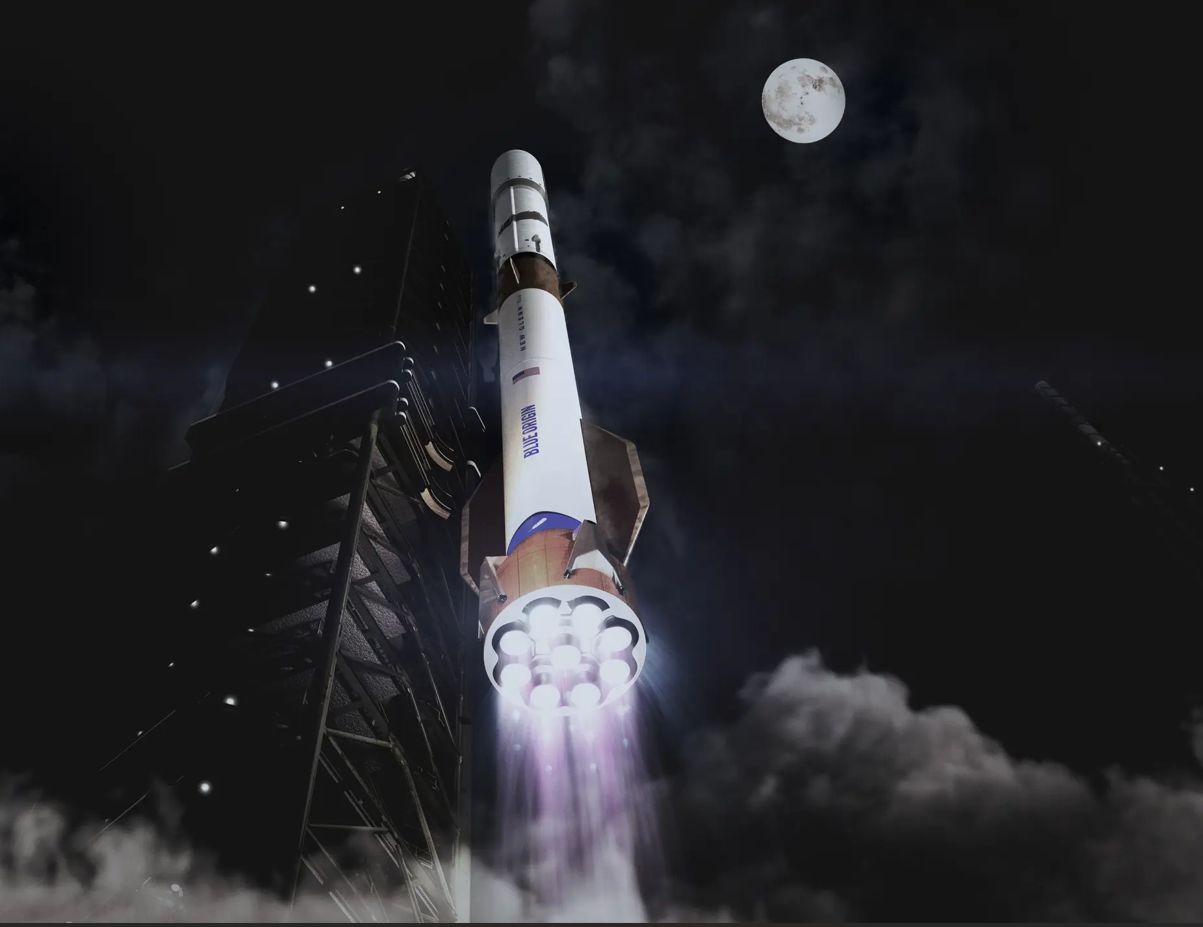
The 9x4 variant of a New Glenn rocket taking off. Credit: Blue Origin
One week after the successful second launch of its large New Glenn booster, Blue Origin revealed a roadmap on Thursday for upgrades to the rocket, including a new variant with more main engines and a super-heavy lift capability.
These upgrades to the rocket are “designed to increase payload performance and launch cadence, while enhancing reliability,” the company said in an update published on its website. The enhancements will be phased in over time, starting with the third launch of New Glenn, which is likely to occur during the first half of 2026.
A bigger beast
The most significant part of the update concerned an evolution of New Glenn that will transform the booster into a super-heavy lift launch vehicle. The first stage of this evolved vehicle will have nine BE-4 engines instead of seven, and the upper stage four BE-4 engines instead of two. In its update, Blue Origin refers to the new vehicle as 9×4 and the current variant as 7×2, a reference to the number of engines in each stage.
“New Glenn 9×4 is designed for a subset of missions requiring additional capacity and performance,” the company said. “The vehicle carries over 70 metric tons to low-Earth orbit, over 14 metric tons direct to geosynchronous orbit, and over 20 metric tons to trans-lunar injection. Additionally, the 9×4 vehicle will feature a larger 8.7-meter fairing.”
The company did not specify a timeline for the debut of the 9×4 variant. A spokesperson for the company told Ars, “We aren’t disclosing a specific timeframe today. The iterative design from our current 7×2 vehicle means we can build this rocket quickly.”
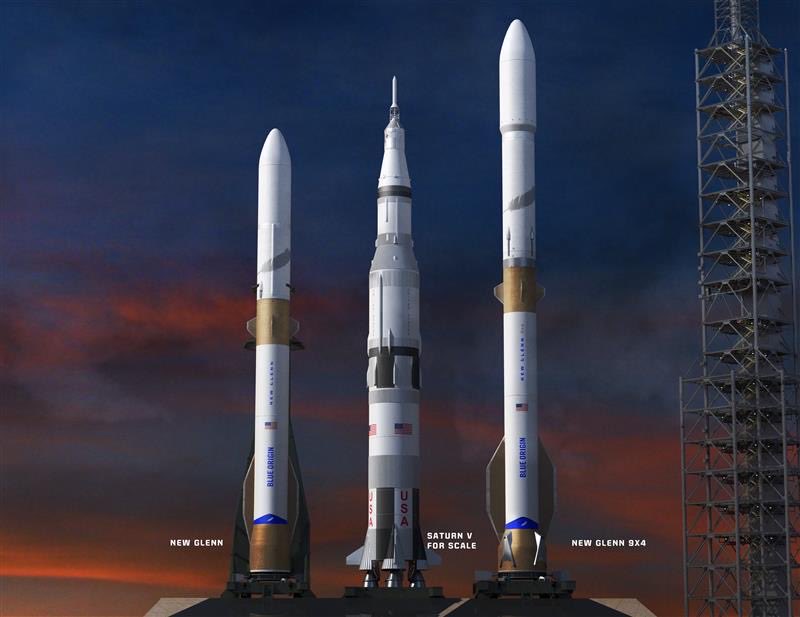
A comparison of New Glenn 7×2, the Saturn V, and New Glenn 7.4 rockets. Credit: Blue Origin
One source familiar with the company’s plans said the internal timeline would allow for the 9×4 variant of New Glenn to take flight as early as 2027.
Such a booster would be a notable vehicle, with a lift capacity nearly on par with NASA’s Space Launch System rocket. However, it would have a fully reusable first stage with a larger payload fairing and would likely cost less than one-tenth the estimated $2.2 billion cost of NASA’s super-heavy rocket.
Other changes
Beyond this major upgrade, Blue Origin also announced other modifications intended to improve the overall performance of the rocket:
Blue Origin said that both its 7×2 and 9×4 variants will fly concurrently. This, the company said, will give “customers more launch options for their missions, including mega-constellations, lunar and deep space exploration, and national security imperatives such as Golden Dome.”
Thursday’s announcement was just the latest in a string of updates from the company. For example, on Wednesday, Blue Origin revealed that it is working on developing a full-scale deployable aerobrake that will be useful for landing large payloads on Mars or slowing down payloads returning to Earth from the Moon.
New leadership
The increased pace of announcements and execution appears to be part of a plan by the company’s chief executive, Dave Limp, to get Blue Origin moving more quickly. Hired by Jeff Bezos from Amazon, Limp has shaken up Blue Origin’s culture, which had stagnated under former CEO Bob Smith despite Bezos showering the company with billions of dollars annually.
In his nearly two years on the job, Limp has focused on expanding Blue Origin’s manufacturing capabilities and pushed for tighter execution on more rigorous deadlines. Before, it would have been possible to dismiss the rocket plans unveiled Thursday as distant goals. But last week’s launch and subsequent landing of the New Glenn rocket suggest the company is finally breaking out.
“I think we’ve made a bunch of progress,” Limp told Ars in a recent interview. “The key cultural shift that we’re trying to achieve is to move from an R&D company to a manufacturing and an operational space company. There are a lot of pieces that go into that. I think in every one of our businesses, we’re making progress. We’re not done. I don’t want to get too far out over our skis here. But I feel like we’re making a lot of progress.”
It does indeed.
The 9x4 variant of a New Glenn rocket taking off. Credit: Blue Origin
One week after the successful second launch of its large New Glenn booster, Blue Origin revealed a roadmap on Thursday for upgrades to the rocket, including a new variant with more main engines and a super-heavy lift capability.
These upgrades to the rocket are “designed to increase payload performance and launch cadence, while enhancing reliability,” the company said in an update published on its website. The enhancements will be phased in over time, starting with the third launch of New Glenn, which is likely to occur during the first half of 2026.
A bigger beast
The most significant part of the update concerned an evolution of New Glenn that will transform the booster into a super-heavy lift launch vehicle. The first stage of this evolved vehicle will have nine BE-4 engines instead of seven, and the upper stage four BE-4 engines instead of two. In its update, Blue Origin refers to the new vehicle as 9×4 and the current variant as 7×2, a reference to the number of engines in each stage.
“New Glenn 9×4 is designed for a subset of missions requiring additional capacity and performance,” the company said. “The vehicle carries over 70 metric tons to low-Earth orbit, over 14 metric tons direct to geosynchronous orbit, and over 20 metric tons to trans-lunar injection. Additionally, the 9×4 vehicle will feature a larger 8.7-meter fairing.”
The company did not specify a timeline for the debut of the 9×4 variant. A spokesperson for the company told Ars, “We aren’t disclosing a specific timeframe today. The iterative design from our current 7×2 vehicle means we can build this rocket quickly.”
A comparison of New Glenn 7×2, the Saturn V, and New Glenn 7.4 rockets. Credit: Blue Origin
One source familiar with the company’s plans said the internal timeline would allow for the 9×4 variant of New Glenn to take flight as early as 2027.
Such a booster would be a notable vehicle, with a lift capacity nearly on par with NASA’s Space Launch System rocket. However, it would have a fully reusable first stage with a larger payload fairing and would likely cost less than one-tenth the estimated $2.2 billion cost of NASA’s super-heavy rocket.
Other changes
Beyond this major upgrade, Blue Origin also announced other modifications intended to improve the overall performance of the rocket:
- Increasing the thrust of a BE-4 engine from current levels, 550,000 pounds (lbf), to 640,000 pounds
- Increasing thrust of BE-3U upper stage engines from 320,000 pounds to 400,000 pounds
- Use of super-cooled cryogenic propellants
- Development of a reusable payload fairing
- Higher performing and more reusable heat shield to reduce refurbishment time
- Lower-cost tank design (presumably for the upper stage, which is not reusable)
Blue Origin said that both its 7×2 and 9×4 variants will fly concurrently. This, the company said, will give “customers more launch options for their missions, including mega-constellations, lunar and deep space exploration, and national security imperatives such as Golden Dome.”
Thursday’s announcement was just the latest in a string of updates from the company. For example, on Wednesday, Blue Origin revealed that it is working on developing a full-scale deployable aerobrake that will be useful for landing large payloads on Mars or slowing down payloads returning to Earth from the Moon.
New leadership
The increased pace of announcements and execution appears to be part of a plan by the company’s chief executive, Dave Limp, to get Blue Origin moving more quickly. Hired by Jeff Bezos from Amazon, Limp has shaken up Blue Origin’s culture, which had stagnated under former CEO Bob Smith despite Bezos showering the company with billions of dollars annually.
In his nearly two years on the job, Limp has focused on expanding Blue Origin’s manufacturing capabilities and pushed for tighter execution on more rigorous deadlines. Before, it would have been possible to dismiss the rocket plans unveiled Thursday as distant goals. But last week’s launch and subsequent landing of the New Glenn rocket suggest the company is finally breaking out.
“I think we’ve made a bunch of progress,” Limp told Ars in a recent interview. “The key cultural shift that we’re trying to achieve is to move from an R&D company to a manufacturing and an operational space company. There are a lot of pieces that go into that. I think in every one of our businesses, we’re making progress. We’re not done. I don’t want to get too far out over our skis here. But I feel like we’re making a lot of progress.”
It does indeed.
