


- Регистрация
- 17 Февраль 2018
- Сообщения
- 40 948
- Лучшие ответы
- 0
- Реакции
- 0
- Баллы
- 8 093
Offline
NASA spent most of Monday trying to overcome hydrogen leaks on the Artemis II rocket.
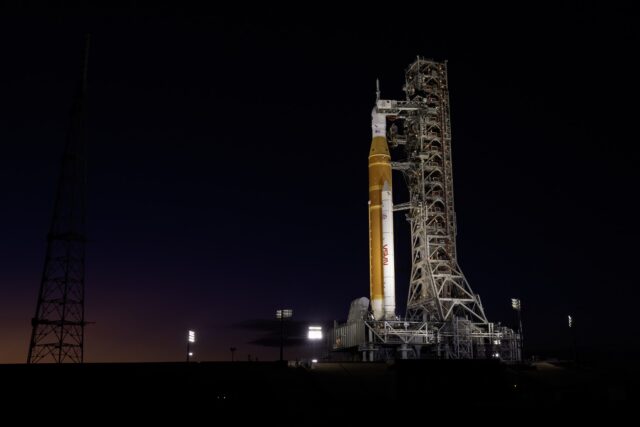
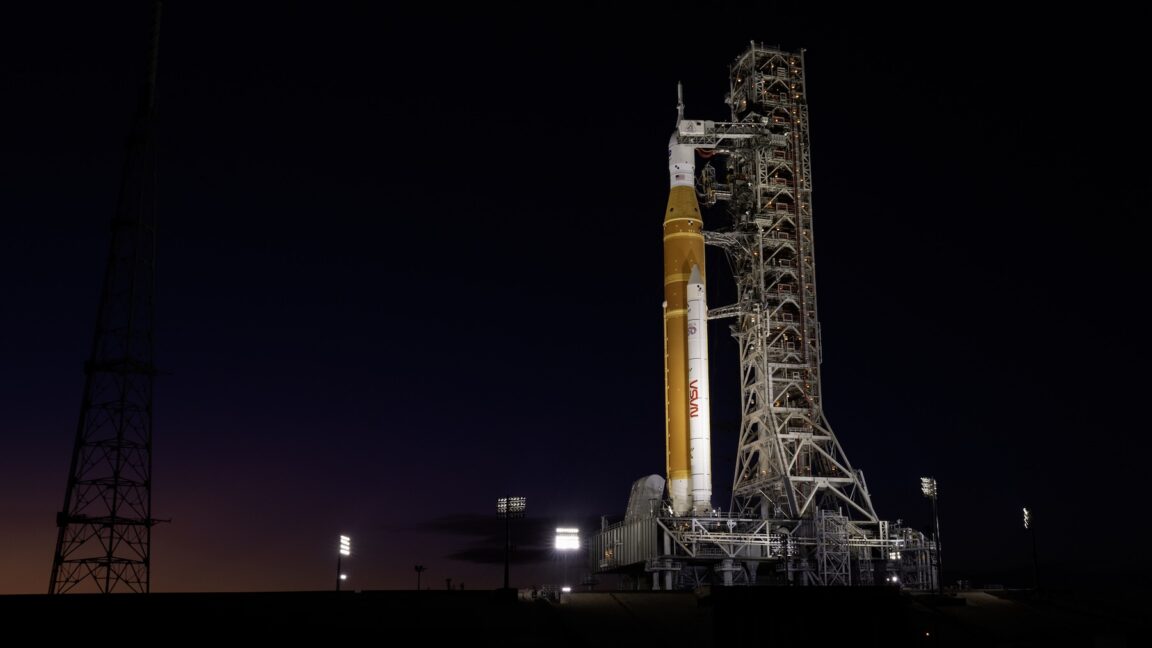
NASA's second Space Launch System rocket stands on Launch Complex 39B at Kennedy Space Center in Florida. Credit: NASA/Jim Ross
The launch of NASA’s Artemis II mission, the first flight of astronauts to the Moon in more than 53 years, will have to wait another month after a fueling test Monday uncovered hydrogen leaks in the connection between the rocket and its launch platform at Kennedy Space Center in Florida.
“Engineers pushed through several challenges during the two-day test and met many of the planned objectives,” NASA said in a statement following the conclusion of the mock countdown, or Wet Dress Rehearsal (WDR), early Tuesday morning. “To allow teams to review data and conduct a second Wet Dress Rehearsal, NASA now will target March as the earliest possible launch opportunity for the flight test.”
The practice countdown was designed to identify problems and provide NASA an opportunity to fix them before launch. Most importantly, the test revealed NASA still has not fully resolved recurring hydrogen leaks that delayed the launch of the unpiloted Artemis I test flight by several months in 2022. Artemis I finally launched successfully after engineers revised their hydrogen loading procedures to overcome the leak.
Now, the second Space Launch System (SLS) rocket is on the cusp of launching a crew for the first time. The Artemis II mission will send four astronauts inside NASA’s Orion spacecraft on a loop around the far side of the Moon on the first crewed lunar flight since 1972, paving the way for future expeditions to land humans at the Moon’s south pole.
Going into the countdown rehearsal, NASA officials hoped a smooth test would clear the way to launch the Artemis II mission as soon as Sunday, February 8. NASA has only a handful of launch opportunities for Artemis II each month, when the Moon is in the right location in its orbit to allow the Orion spacecraft to fly a so-called free return trajectory and come back to Earth for a safe reentry and splashdown.
The first launch opportunity for Artemis II next month is March 6, with a two-hour launch window opening at 8:29 pm EST (01:26 UTC on March 7).
Artemis II commander Reid Wiseman, pilot Victor Glover, mission specialist Christina Koch, and Canadian astronaut Jeremy Hansen have been in medical quarantine since January 21, a standard practice for astronauts preparing to fly to space. They will now be released from quarantine at their home base in Houston to resume training and await a new launch date.
An all-day roller coaster
NASA’s Artemis launch team, stationed a few miles away from the SLS rocket on its seaside launch pad, started fueling operations around midday Monday, somewhat later than scheduled due to cold temperatures at the Florida spaceport. The launch team first detected leaking hydrogen soon after they began loading the super-cold fuel into the SLS core stage.
The leak appeared in the same location it did during the Artemis I launch campaign nearly three years ago. Liquid hydrogen and liquid oxygen flow from ground storage tanks into the SLS core stage through so-called Tail Service Mast Umbilicals (TSMUs), two roughly 30-foot-tall gray pods rising from the base of the rocket’s mobile launch platform. The TSMUs route propellant lines through connections near the bottom of the core stage, where umbilical plates on the rocket side and ground side meet. At liftoff, the umbilical plates disconnect as the rocket begins its climb off the launch pad.
Hydrogen is one of the most efficient rocket fuels, but it is notoriously difficult to handle. Liquified hydrogen must be stored at minus 423° Fahrenheit (minus 253° Celsius), cold enough to change the shape and size of seals and other soft goods in the fueling line. This can create leak paths not readily detectable at ambient temperatures. Hydrogen molecules are the smallest and lightest in the Universe, with the ability to find their way through the tiniest of breaches.
Because of this, NASA engineers accept that a small amount of hydrogen will escape seals in the fueling line. Agency officials said in 2022 that the safe limit was a 4 percent concentration of hydrogen gas in the housing around the fueling connector. Hydrogen levels exceeded NASA’s safety limit multiple times during the practice countdown that ran from Monday into early Tuesday.
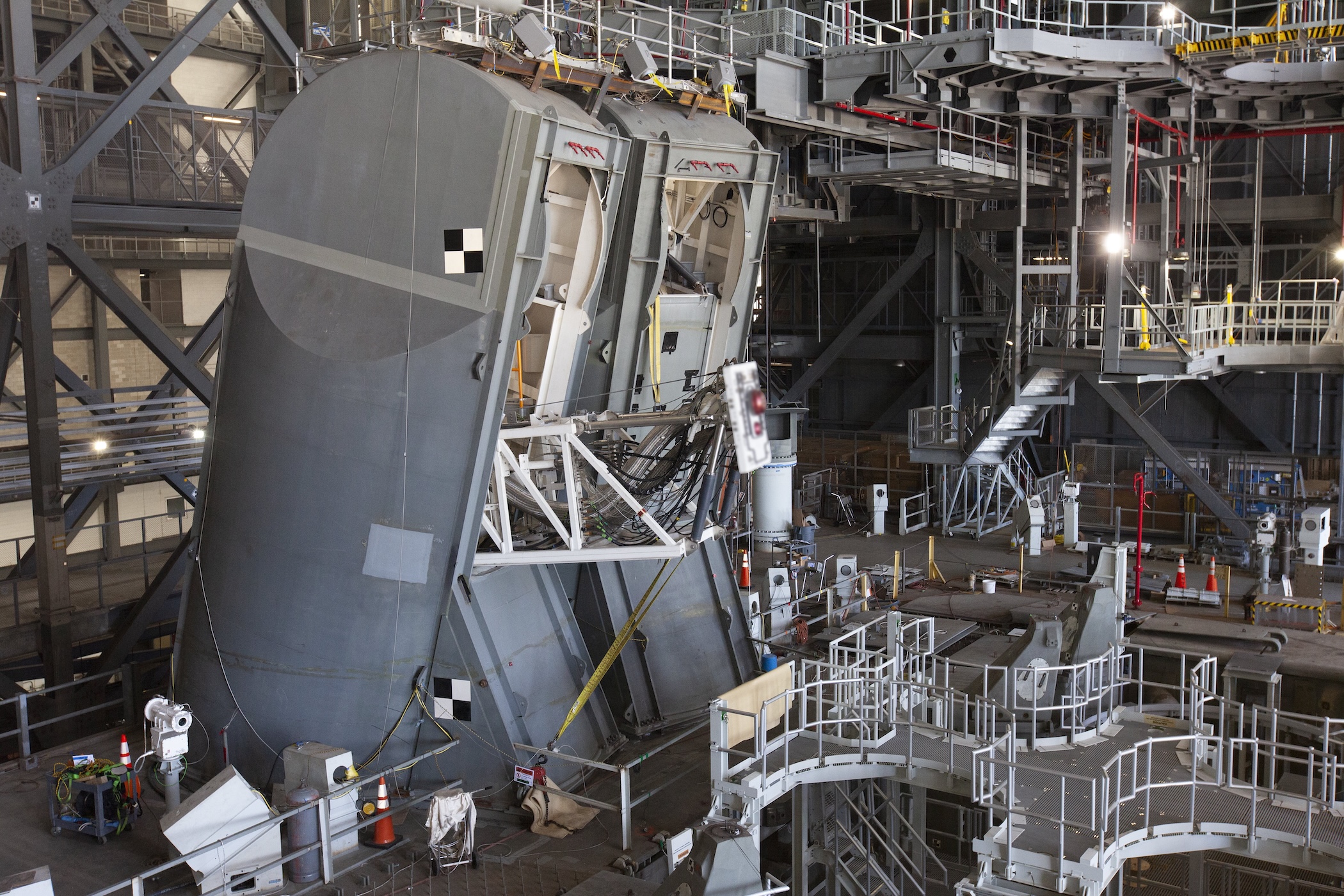
This photo taken in 2019 shows the liquid hydrogen Tail Service Mast Umbilical undergoing tests inside the Vehicle Assembly Building. The connector plate is visible at the end of the arm in the center of the photo. Credit: NASA
“ Attempts to resolve the issue involved stopping the flow of liquid hydrogen into the core stage, allowing the interface to warm up for the seals to reseat, and adjusting the flow of the propellant,” NASA said in a statement.
NASA appeared to get past the problem Monday evening and fully loaded the 322-foot-tall (98-meter) rocket with more than 750,000 gallons of propellant.
With fueling complete, managers sent a closeout crew to the launch pad around 6:00 pm EST (23:00 UTC) to close the hatch to the Orion spacecraft sitting atop the SLS rocket. The closeout team will help the Artemis II astronauts into the Orion capsule on launch day, but the crew was not part of the practice countdown Monday night.
The closeout crew took longer than anticipated to close and secure the hatch to the Orion spacecraft. A valve associated with Orion’s hatch pressurization inadvertently vented, according to NASA, requiring the closeout crew to retorque the valve. The launch team dealt with several other glitches, including audio dropouts on ground communication loops and camera problems believed to be caused by recent cold weather in Central Florida.
Finally, with the closeout crew a safe distance away from the rocket, the launch team gave approval to begin the final 10 minutes of the countdown shortly after midnight Tuesday. The objective was to stop the countdown clock 33 seconds prior to launch, about the same time the rocket would take control of the countdown during a real launch attempt.
Instead, the clock stopped at T-minus 5 minutes and 15 seconds. NASA said the countdown terminated “due to a spike in the liquid hydrogen leak rate.” The countdown ended before the rocket switched to internal power and fully pressurized its four propellant tanks. The test also concluded before the rocket activated its auxiliary power units to run the core stage’s four main engines through a preflight steering check, all milestones engineers hoped to cross off their checklist.
Launch controllers began work to drain the SLS rocket’s propellant tanks after calling an end to the countdown. With the test incomplete, NASA managers quickly decided to hold off on launching the Artemis II mission to allow time for ground teams to “fully review data from the test, mitigate each issue, and return to testing ahead of setting an official target launch date.”
“As always, safety remains our top priority, for our astronauts, our workforce, our systems, and the public,” NASA Administrator Jared Isaacman said in a social media post. “We will only launch when we believe we are ready to undertake this historic mission.”
Officials did not immediately announce when they might be ready for a second Wet Dress Rehearsal, or whether they plan to roll the rocket back to its assembly building for repairs. NASA managers plan to hold a press briefing Tuesday afternoon to discuss the results of the test in more detail.
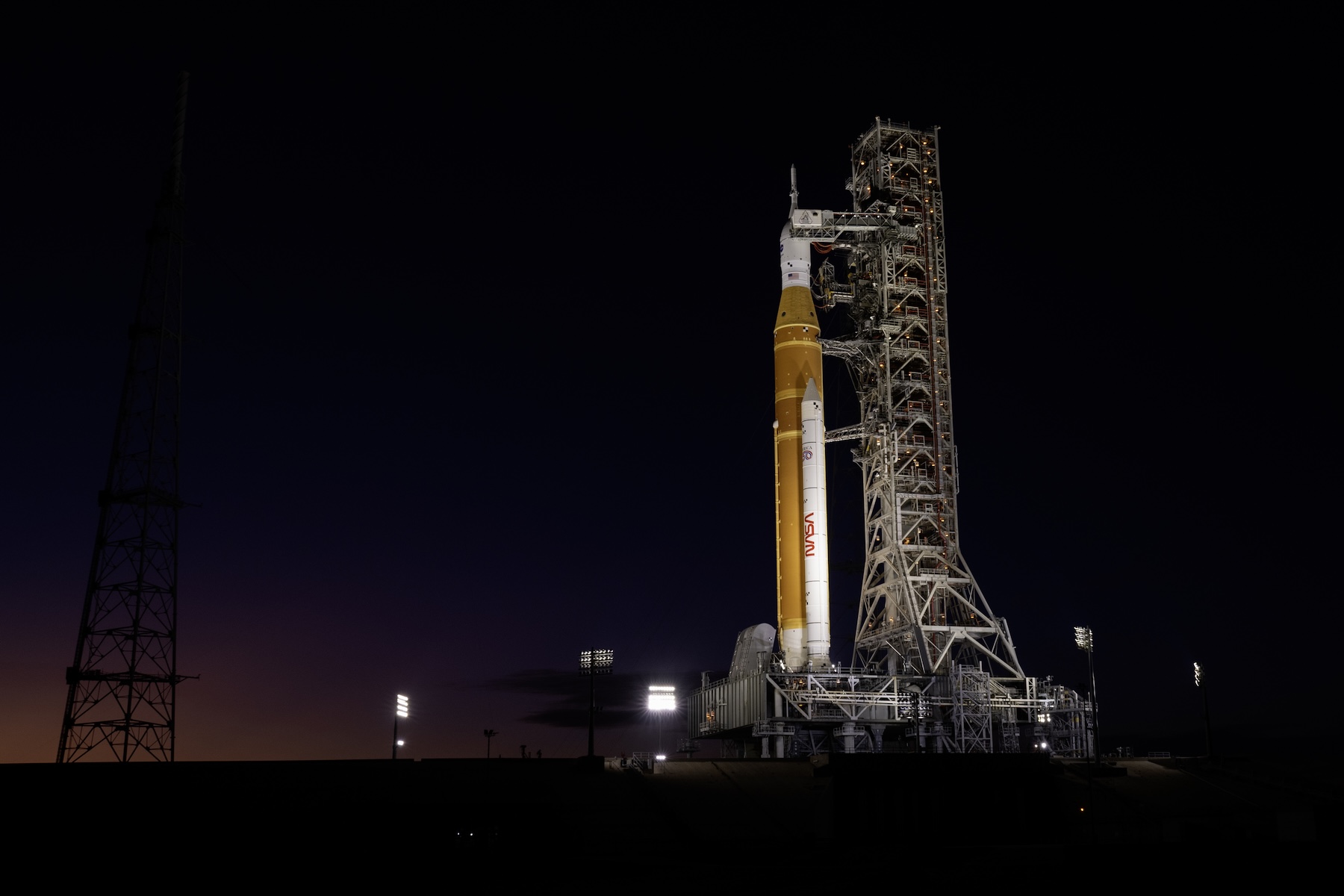
NASA's second Space Launch System rocket stands on Launch Complex 39B at Kennedy Space Center in Florida. Credit: NASA/Jim Ross
The launch of NASA’s Artemis II mission, the first flight of astronauts to the Moon in more than 53 years, will have to wait another month after a fueling test Monday uncovered hydrogen leaks in the connection between the rocket and its launch platform at Kennedy Space Center in Florida.
“Engineers pushed through several challenges during the two-day test and met many of the planned objectives,” NASA said in a statement following the conclusion of the mock countdown, or Wet Dress Rehearsal (WDR), early Tuesday morning. “To allow teams to review data and conduct a second Wet Dress Rehearsal, NASA now will target March as the earliest possible launch opportunity for the flight test.”
The practice countdown was designed to identify problems and provide NASA an opportunity to fix them before launch. Most importantly, the test revealed NASA still has not fully resolved recurring hydrogen leaks that delayed the launch of the unpiloted Artemis I test flight by several months in 2022. Artemis I finally launched successfully after engineers revised their hydrogen loading procedures to overcome the leak.
Now, the second Space Launch System (SLS) rocket is on the cusp of launching a crew for the first time. The Artemis II mission will send four astronauts inside NASA’s Orion spacecraft on a loop around the far side of the Moon on the first crewed lunar flight since 1972, paving the way for future expeditions to land humans at the Moon’s south pole.
Going into the countdown rehearsal, NASA officials hoped a smooth test would clear the way to launch the Artemis II mission as soon as Sunday, February 8. NASA has only a handful of launch opportunities for Artemis II each month, when the Moon is in the right location in its orbit to allow the Orion spacecraft to fly a so-called free return trajectory and come back to Earth for a safe reentry and splashdown.
The first launch opportunity for Artemis II next month is March 6, with a two-hour launch window opening at 8:29 pm EST (01:26 UTC on March 7).
Artemis II commander Reid Wiseman, pilot Victor Glover, mission specialist Christina Koch, and Canadian astronaut Jeremy Hansen have been in medical quarantine since January 21, a standard practice for astronauts preparing to fly to space. They will now be released from quarantine at their home base in Houston to resume training and await a new launch date.
An all-day roller coaster
NASA’s Artemis launch team, stationed a few miles away from the SLS rocket on its seaside launch pad, started fueling operations around midday Monday, somewhat later than scheduled due to cold temperatures at the Florida spaceport. The launch team first detected leaking hydrogen soon after they began loading the super-cold fuel into the SLS core stage.
The leak appeared in the same location it did during the Artemis I launch campaign nearly three years ago. Liquid hydrogen and liquid oxygen flow from ground storage tanks into the SLS core stage through so-called Tail Service Mast Umbilicals (TSMUs), two roughly 30-foot-tall gray pods rising from the base of the rocket’s mobile launch platform. The TSMUs route propellant lines through connections near the bottom of the core stage, where umbilical plates on the rocket side and ground side meet. At liftoff, the umbilical plates disconnect as the rocket begins its climb off the launch pad.
Hydrogen is one of the most efficient rocket fuels, but it is notoriously difficult to handle. Liquified hydrogen must be stored at minus 423° Fahrenheit (minus 253° Celsius), cold enough to change the shape and size of seals and other soft goods in the fueling line. This can create leak paths not readily detectable at ambient temperatures. Hydrogen molecules are the smallest and lightest in the Universe, with the ability to find their way through the tiniest of breaches.
Because of this, NASA engineers accept that a small amount of hydrogen will escape seals in the fueling line. Agency officials said in 2022 that the safe limit was a 4 percent concentration of hydrogen gas in the housing around the fueling connector. Hydrogen levels exceeded NASA’s safety limit multiple times during the practice countdown that ran from Monday into early Tuesday.
This photo taken in 2019 shows the liquid hydrogen Tail Service Mast Umbilical undergoing tests inside the Vehicle Assembly Building. The connector plate is visible at the end of the arm in the center of the photo. Credit: NASA
“ Attempts to resolve the issue involved stopping the flow of liquid hydrogen into the core stage, allowing the interface to warm up for the seals to reseat, and adjusting the flow of the propellant,” NASA said in a statement.
NASA appeared to get past the problem Monday evening and fully loaded the 322-foot-tall (98-meter) rocket with more than 750,000 gallons of propellant.
With fueling complete, managers sent a closeout crew to the launch pad around 6:00 pm EST (23:00 UTC) to close the hatch to the Orion spacecraft sitting atop the SLS rocket. The closeout team will help the Artemis II astronauts into the Orion capsule on launch day, but the crew was not part of the practice countdown Monday night.
The closeout crew took longer than anticipated to close and secure the hatch to the Orion spacecraft. A valve associated with Orion’s hatch pressurization inadvertently vented, according to NASA, requiring the closeout crew to retorque the valve. The launch team dealt with several other glitches, including audio dropouts on ground communication loops and camera problems believed to be caused by recent cold weather in Central Florida.
Finally, with the closeout crew a safe distance away from the rocket, the launch team gave approval to begin the final 10 minutes of the countdown shortly after midnight Tuesday. The objective was to stop the countdown clock 33 seconds prior to launch, about the same time the rocket would take control of the countdown during a real launch attempt.
Instead, the clock stopped at T-minus 5 minutes and 15 seconds. NASA said the countdown terminated “due to a spike in the liquid hydrogen leak rate.” The countdown ended before the rocket switched to internal power and fully pressurized its four propellant tanks. The test also concluded before the rocket activated its auxiliary power units to run the core stage’s four main engines through a preflight steering check, all milestones engineers hoped to cross off their checklist.
Launch controllers began work to drain the SLS rocket’s propellant tanks after calling an end to the countdown. With the test incomplete, NASA managers quickly decided to hold off on launching the Artemis II mission to allow time for ground teams to “fully review data from the test, mitigate each issue, and return to testing ahead of setting an official target launch date.”
“As always, safety remains our top priority, for our astronauts, our workforce, our systems, and the public,” NASA Administrator Jared Isaacman said in a social media post. “We will only launch when we believe we are ready to undertake this historic mission.”
Officials did not immediately announce when they might be ready for a second Wet Dress Rehearsal, or whether they plan to roll the rocket back to its assembly building for repairs. NASA managers plan to hold a press briefing Tuesday afternoon to discuss the results of the test in more detail.
